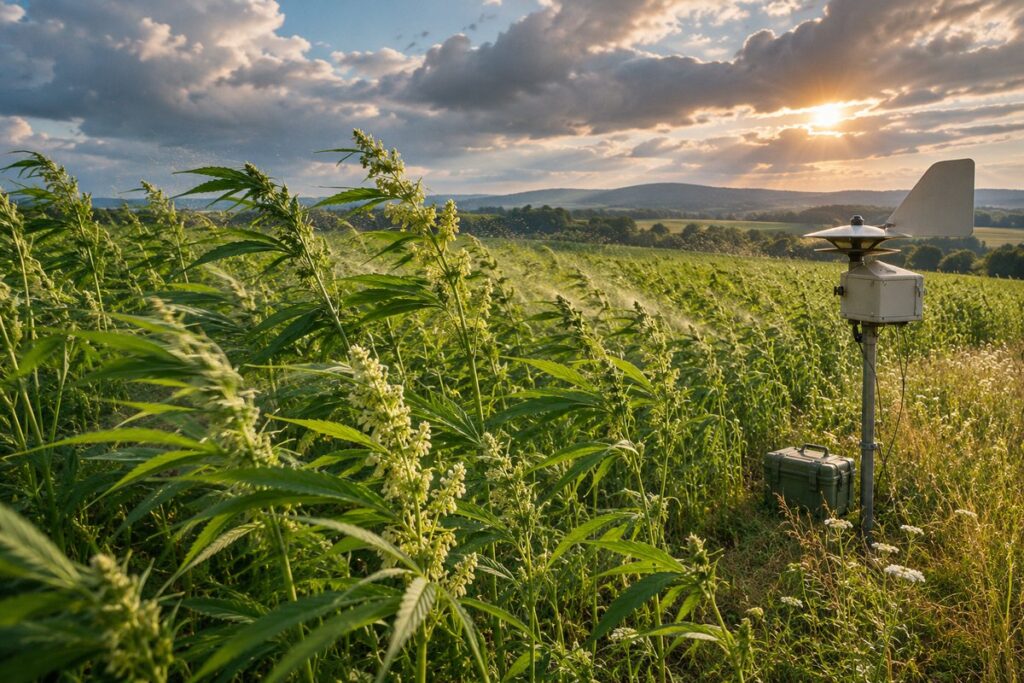
A pollen trap near a hemp field caught grains 400 metres from their source. Four hundred metres sounds like a natural boundary. In fact, it tells us where somebody chose to set a trap. Had they set it a little farther away, would the count have fallen to zero? And if a trap caught just one grain, would a plant growing beside it have produced a seed?
Those questions call for three different sorts of evidence. A collector records arrival at a particular spot. An atmospheric model estimates where particles could travel. A plant can supply evidence that a grain arrived in the right place, at the right time, and was still capable of fertilization. Much of the apparent disagreement about pollen distances comes from switching among those three meanings.
A trap has an address
In a Canadian field experiment, researchers set collectors at different distances from a known source of hemp pollen. By 400 metres the catch was small compared with the pollen rain near the source, yet grains were still arriving. Cornell’s account of the field work points out a quiet but consequential detail. The Canadian team measured pollen rain. They did not survey fertilization of female plants.
A trap also samples one location over a particular period. Wind on the day of flowering helps decide whether a collector sits in the path of a passing plume. Low numbers at a single trap can coexist with larger numbers elsewhere at the same distance. Placing collectors in several directions and keeping track of the wind make the counts much easier to interpret.
Release the same pollen into different skies
A United States modelling study approached the problem from the opposite end. The researchers simulated airborne particles with the settling properties of cannabis pollen and followed their deposition under different atmospheric conditions. They compared daytime and nighttime releases across regions and months. Their output was a distribution of landing distances. It allows a reader to ask what happens close to the source and what happens to the relatively small fraction that travels farther.
Air near sun-warmed ground mixes vertically. A grain swept upward can remain aloft while horizontal winds carry it downwind. At night the air near the surface is often more stable. In the simulations, deposition within the first ten kilometres was markedly greater at night than during the day. This comparison describes what the model did with particles released at those times. Estimating what an actual field contributes also requires knowing how much pollen flowers release at each hour.
A landing place is only the beginning
Hemp pollen can land on bare soil, water, a collector or another plant. It can even be collected by a bee. A survey of bees visiting hemp documented insects using the crop as a pollen resource. A bee carrying pollen is good evidence of foraging. Standing alone, the observation cannot establish which plant, if any, received a viable grain from that visitor.
For fertilization, a receptive female flower has to be present when the pollen arrives. Timing of flowering and survival of grains during transport both enter the picture. Cornell’s field work also illustrates a more direct approach, placing female plants at known distances and later examining seed formation. Such a trial measures a biological outcome, though linking it to one particular source becomes more difficult if there are other flowering hemp plants nearby.
The next time a pollen map gives a precise-looking distance, look for the unit behind the line. Grains caught per collector, particles predicted to land, and seeds recovered per plant describe successive events in a much longer journey. The experiment at 400 metres answered the first question with an actual catch. There were still two more questions to go.