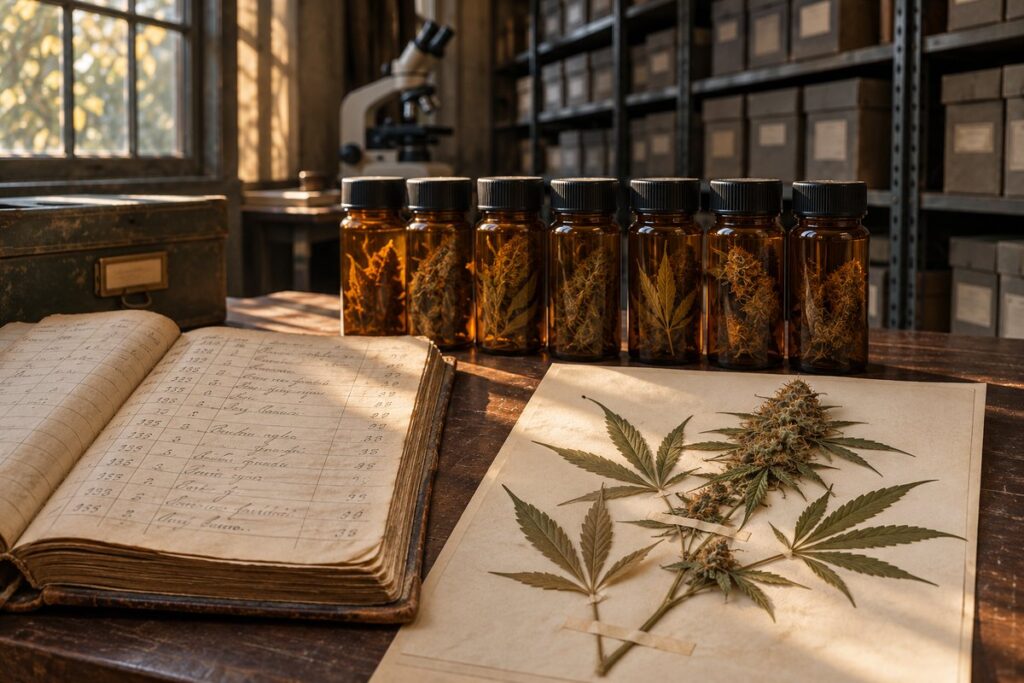
On day one, the six cannabis samples already looked like poor candidates for comparison. There was loose flower, compressed flower, hard resin and an oily material quite unlike the others. One started at roughly 10 percent THC. Another contained more than five times as much. Four years later, comparing those two items would have revealed very little about aging. The useful comparison was between each item and an earlier version of itself.
That distinction matters in a forensic laboratory, where a second analysis might take place years after the first. An analyst who gets a different result has several possibilities to consider. Did the two portions differ from the beginning? Has the instrument given a different answer? Or has the evidence itself changed in the meantime?
Four histories for the same material
A team led by Luca Zamengo gave portions of each material four different storage histories. Two stayed at room temperature, one exposed to light and the other in darkness. The remaining portions were kept in the dark under colder conditions. Roughly every hundred days, the team took small test portions and analyzed them, including duplicate measurements. The four-year experiment thus produced a series of observations for each starting material.
Think of the first pair as an experiment within the experiment. Both portions had spent the same number of days at room temperature. The contrast between them let the researchers examine the role of light. Comparing a room-temperature sample exposed to light with a cold sample kept in darkness would have changed two things at once. An earlier study of herbal cannabis used that combined comparison and also found different rates of THC loss. The extra room-temperature sample helps explain where the difference comes from.
Following more than one compound
The analysts tracked THC alongside cannabinol, usually abbreviated CBN. THC can give rise to CBN as it degrades. An early storage experiment had already shown that exposure to air and exposure to light could leave different chemical traces. It is tempting to picture the process as one number ticking down while a second ticks up by exactly the corresponding amount. If chemistry worked that neatly, a single measurement of CBN might tell an analyst what had happened to all the missing THC.
The curves told a less tidy story. Temperature affected how fast the composition changed, while exposure to light also affected the relationship between the amount of THC disappearing and the amount of CBN appearing. Two results from the same day could therefore look different for a perfectly ordinary reason. The portions had been on different shelves. In the laboratory record, a note about light exposure could be as consequential as the date on the label.
Duplicate tests helped with a different source of uncertainty. Repeating an analysis on one portion gives some idea of analytical variation. Taking another portion also samples the material’s own unevenness. A difference between two isolated readings is hard to interpret when neither source of variation is known. A succession of measurements moving in a consistent direction is much easier to defend.
Could a lab run the clock backward?
The team fitted mathematical curves to its measurements and explored whether they could estimate elapsed time or reconstruct an earlier THC concentration. Predictions became more uncertain at longer times. A later study of stored cannabis resin likewise examined how patterns across compounds might inform an estimate of age. In either case, a calculation inherits the conditions of the samples used to build it.
Imagine handing two analysts identical final results. The first also receives the initial measurement and a storage log. The second gets a jar of unknown origin. The first can ask whether the observed change is plausible for that particular material and history. The second must guess at both. Four years of careful observations make the first question considerably easier to answer. They also show just how much information is missing from the second analyst’s jar.